
I’m Building 100 Mini Websites.
And You Can Build Them Too.
Simple sites. Low operating costs. AI-assisted building. Multiple income opportunities. Many designed to run largely on autopilot.
And you can build as many of these mini-sites as you want.
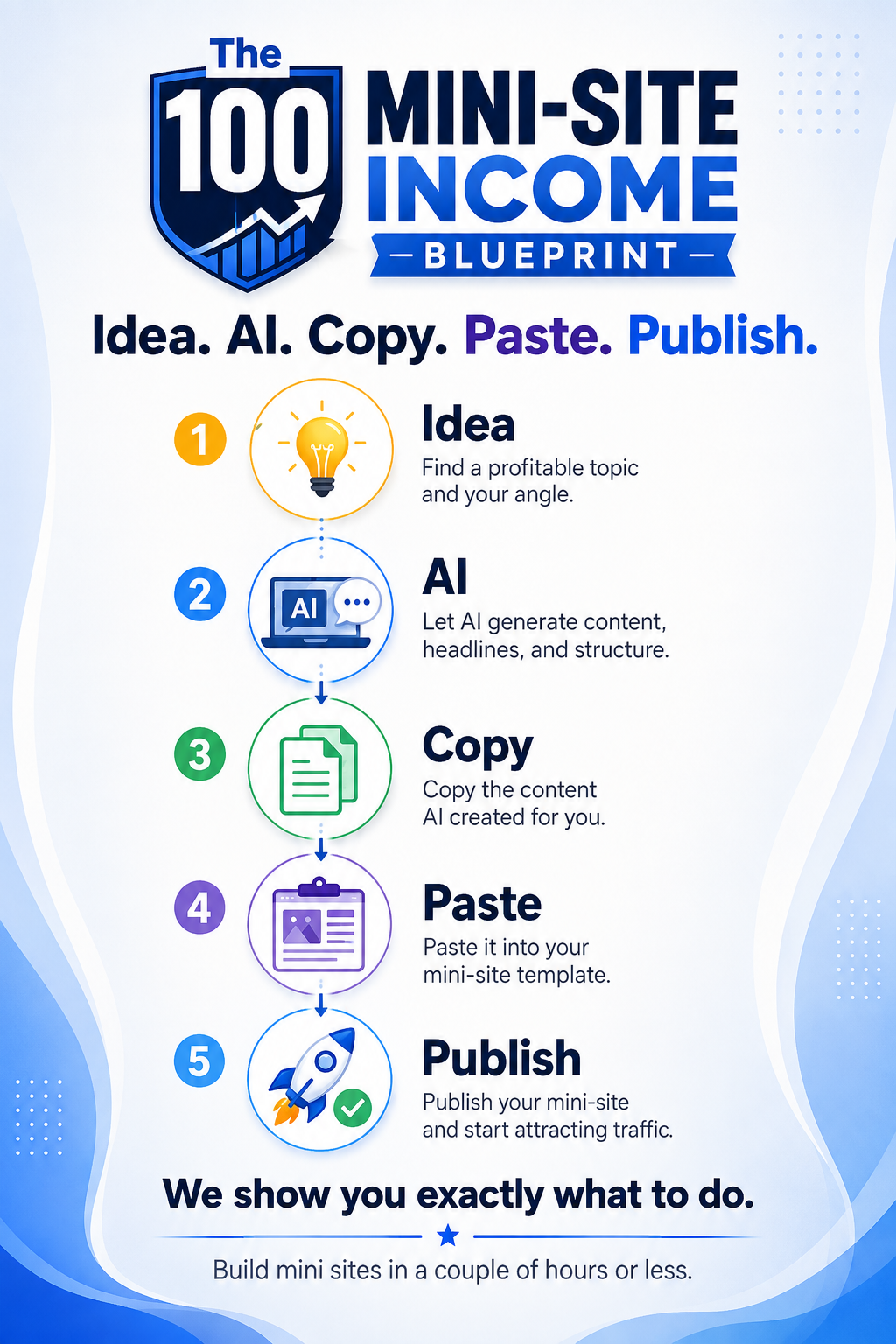
I Want You To Look At This Blueprint And Say, “Yeah. I Can Do That Too.”
You don’t have to be a programmer. You don’t need employees. You don’t need one giant business. Start with one mini-site, learn from it, then build the next. Build one, ten, 100 or more — you decide how far you want to take it.
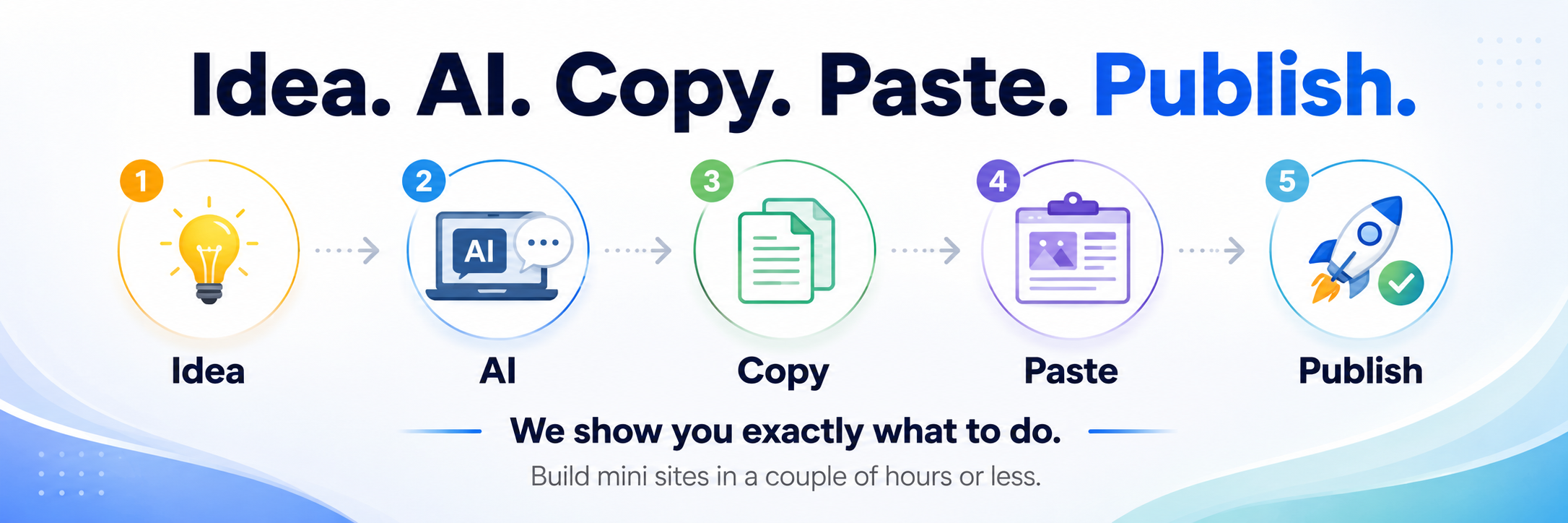
We Show You Exactly What To Do.
Tell AI what you want the site to do. Have AI create the code. Copy it. Paste it. Publish it.
One Site Doesn’t Have To Make You Rich.
My target for each mini-site is $410 to $4,100 per year — but that’s a target, not a ceiling.
Some sites may earn less. Some may earn more.
One of my sites earned more than $7,800 last year.
That doesn’t mean every mini-site will do that. It simply shows why I like building a portfolio instead of depending on one website.
You don’t need every site to be a winner. You need enough sites to give yourself multiple chances to win.
I’m building a portfolio of digital properties.
One Mini-Site Is Income. A Portfolio Can Become An Asset.
Imagine building 100 mini-sites.
If every one of them only hit the bottom of my target — $410 per year — that would be $41,000 a year in gross income across the portfolio.
At my current operating target of just about $22 cost per site per year, each site only needs a small amount of income to cover its own annual cost. Everything above that begins contributing to the portfolio.
A Modest 100-Site Scenario
Here’s another way to look at the model.
If 80 of your 100 mini-sites produced just $410 per year, that would generate $32,800 per year.
If the remaining 20% — just 20 sites — grew to around $4,000 per year each, those sites would generate another $80,000 per year.
$112,800 Per Year
That’s the kind of portfolio this model is designed to make possible: lots of small income-producing websites, with some becoming much stronger performers.
To me, that’s a modest illustration of what a growing mini-site portfolio can look like when you keep building, testing and adding recurring-income opportunities.
This is a hypothetical illustration, not a projection or guarantee. Actual earnings may be lower or higher and depend on traffic, offers, conversion rates, program terms, customer retention and other factors.
400 Mini-Websites.
My personal goal is to build a portfolio of 400 websites, with each one earning a minimum of $1,000 a year in profit.
in annual profit if all 400 hit that minimum goal.
That’s the power of thinking in terms of a portfolio instead of one website.
This is my personal goal, not a guarantee of results.
And remember, my goal is not just $410. My target range is $410 to $4,100 per year, per site.
That means you can keep adding small income-producing websites over time instead of depending on one big idea.
And Recurring Income Can Make The Portfolio Even More Powerful.
A high percentage of the opportunities I’m interested in can generate monthly or annual recurring commissions. So a mini-site may not simply make one sale and stop. Some referrals can continue producing income as long as the customer remains active and the program continues paying commissions.
Now add another site. And another. And another.
You can build a growing portfolio of mini-websites with expanding income — with many of them designed to operate largely on autopilot.
As recurring commissions stack and new sites are added, the income has the potential to compound and accelerate over time.
These figures illustrate the portfolio model and are not income guarantees. Actual results vary by site, offer, traffic, conversion, program terms and customer retention.
One simple idea
Another income path
We Even Show You How To Buy Domains For Less.
Domains are part of the mini-site model, so I pay attention to that cost too.
We have a simple resource that can help you buy domains for up to 60% less than typical GoDaddy public pricing.
That helps keep the annual carrying cost of each mini-site low — which is one reason my estimated operating cost is only about:
About $22 Cost Per Site Per Year
That estimate includes the site’s allocated share of hosting plus the annual domain renewal.
YourSite.com
Keep more of your margin
More Than A Book. A Growing Toolbox.
The book gives you the blueprint. The Moneyroom Universe Community is where you watch the process come alive — and we add more every month.
Alex AI
Brainstorm mini-sites, offers, copy and next steps. All you need is a free ChatGPT account.
Moneyroom Success Music
A mini library of original motivational and success-focused music to use while you work and build.
4 Digital Products
Four digital products during your first 12 months that you can sell for 100% profit. Four possible mini-sites right there.
Traffic Ideas
Learn ways to get people to your sites using social media, email, content, video, YouTube and campaigns.
Email List Building
Learn how to start building your own list with a platform offering up to 2,000 subscribers free.
AI Mobile Apps
See how AI can help you create mobile apps at light speed and at very little cost.
YouTube + Faceless YouTube
Create a channel that can become a traffic source, list builder and another potential income-producing asset.
Income Opportunities
Affiliate programs, referral programs, subscriptions, digital products and recurring-income opportunities.
Promotional Resources
Emails, posts, banners, sales copy, AI prompts, videos, campaigns and real examples from the sites I build.
Make the referral
Keep earning*
When Your Mini Site Uses Referral Programs...
You keep the commissions you earn. Many of the income sources we use are built around affiliate, referral, monthly recurring and annual recurring commissions.
In some programs, you can refer a customer once and continue earning while that customer remains active and the program continues paying recurring commissions.
One site may create a few recurring commissions. Another may create a few more. Then another. Then another.
*Recurring commissions depend on each program’s terms and qualifying customers remaining active.
Build It. Sell It. Flip It.
You don’t necessarily have to keep every mini-site you build.
There’s another potential income stream hiding inside this blueprint:
Build Sites Specifically To Sell.
You can create a simple, attractive mini-site around an idea, niche, product or domain — get it built and working — and then offer the entire site for sale.
I see people selling completed websites for $1,000, $1,200, $1,800 or more, depending on the site, domain, content, traffic, revenue and what’s included.
So you have choices.
Build it. Flip it. Build another. Flip another.
Website resale prices vary widely. The figures above are examples, not guaranteed sale prices or earnings.
MiniSiteIdea.com
Turn a build into a sale
I Built This Website Sitting In A Booth At A Cheddar’s Restaurant.
I was having lunch while my partner, Diane, was doing a presentation with a potential client.
Instead of wasting the downtime, I opened up my laptop and worked on another mini-site.
That’s how I approach this.
I don’t wait for the perfect day, a wide-open schedule or hours of uninterrupted time. When I have a pocket of downtime, I use it.
A Little Time Here. Another Mini-Site There.
Over time, those small blocks of effort can turn into a growing portfolio of income-producing websites.
I take advantage of my downtime and build another mini-site whenever I can.
Lunch Break = Build Time
One booth. One laptop. One more mini-site moving forward.
This Mini-Site Blueprint Is Another Example Of The Model.
And as I sell just 1,000 people this Mini-Site Blueprint at $27, this mini-site will generate $27,000 in gross sales.
Think about that. One mini-site. One digital product.
The blueprint itself is another example of the model in action: create a focused site, attach a clear offer, and let that site become part of the larger portfolio.
This is straightforward sales math, not a guarantee that 1,000 sales will occur. Actual sales depend on traffic, offer quality, conversion rates and other factors.
Watch Me Build The 100.
I’m not handing you a book and disappearing. I’ll share the ideas, launches, tools, monetization methods, experiments, mistakes and winners.
Look Over My Shoulder
See what I’m building and why.
See The Experiments
What works, what doesn’t, and what I change.
Avoid Rabbit Holes
Spend more time building and less time wandering through endless tutorials.
$410–$4,100. About $22. A Couple Hours. Autopilot.
About $22 cost per site per year.
That is the combination I keep coming back to: a modest income target per site, low carrying cost, fast AI-assisted builds, and sites designed to keep working after I move on to the next one.
I’m doing it. And you can too.
Start Building Your Mini-Site Portfolio.
Everything you need to follow the 100 Mini-Site Blueprint process, in one simple purchase.
The 100 Mini-Site Income Blueprint
- Complete 100 Mini-Site Income Blueprint
- IDEA → AI → COPY → PASTE → PUBLISH process
- How to build simple mini-sites quickly with AI
- How to keep operating costs around $22 per site per year
- $410–$4,100 annual income target per site
- Recurring affiliate and referral income strategies
- Digital product and lead-generation ideas
- Build sites to keep, grow or flip
- Portfolio strategy for building multiple income-producing sites
Income Disclaimer: Income figures are goals and examples, not guarantees. Results vary based on offers, traffic, effort, market conditions and other factors. Recurring commissions depend on the terms of each individual affiliate or referral program and on qualifying customers remaining active. Operating costs and access to software, hosting and other tools may vary.